Hicks Gesetz

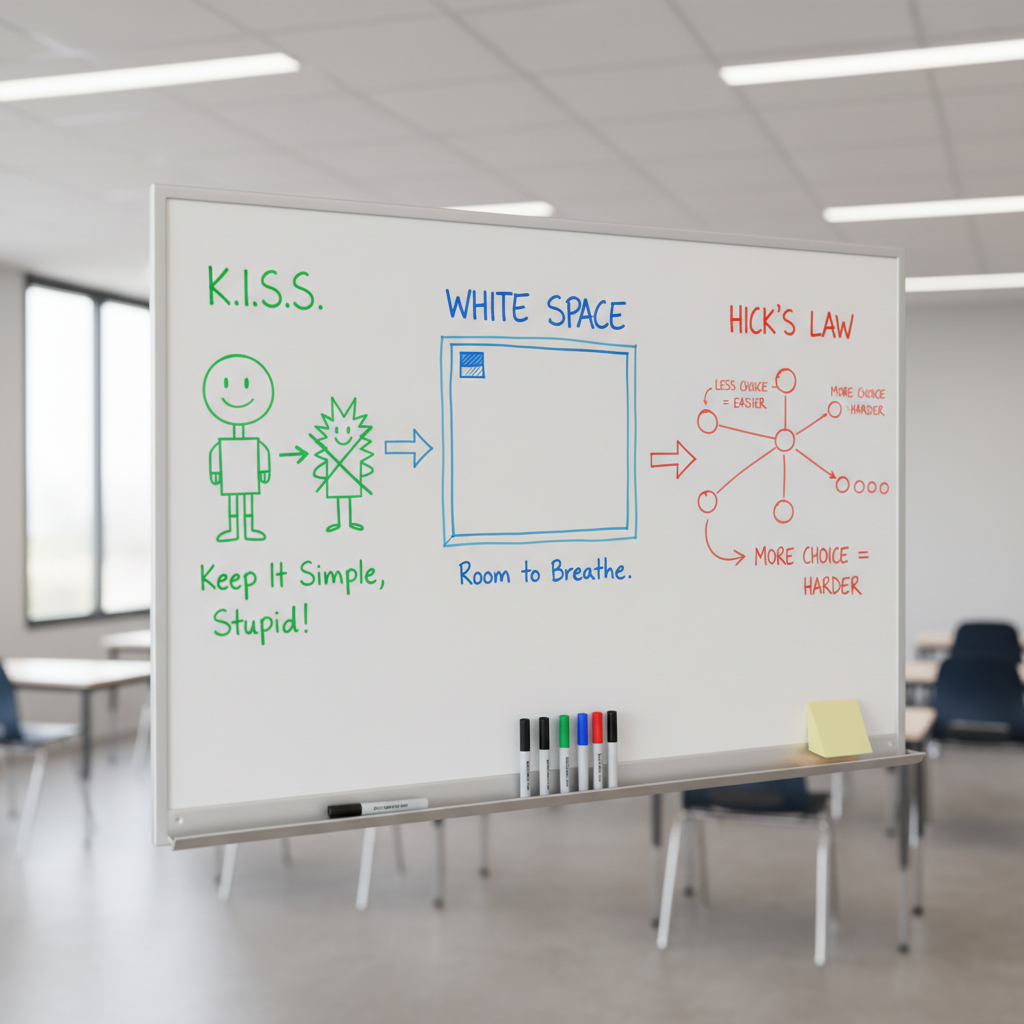
A large, wall-mounted whiteboard in a bright, modern classroom, captured from a slightly angled, eye-level perspective. On the whiteboard, three neatly drawn, color-coded diagrams explain KISS, white space, and Hick’s Law using simple shapes, arrows, and short handwritten labels. Magnetic markers rest in a metal tray beneath, and a stack of blank sticky notes sits on a nearby slim ledge. Soft overhead fluorescent lighting combined with indirect window light keeps the scene evenly lit without harsh glare, making the diagrams crisp and readable. The background shows only blurred hints of empty chairs and a clean floor, emphasizing the board as the main subject. The photographic realism and neutral color palette create a calm, instructional atmosphere suitable for teachers and classmates.

Ursprung

• In der experimentallen Psychologie der frühen 1950er Jahren
• Wurde von dem Psychologen William Edmund Hick entwickelt
• Begründung (1912-1996)
• 1952 eine fundamentale veröffentliche Studie dazu

Bedeutung

•Hickshe Gesetz – Hick-Hyman-Gesetz
• Besagten die Zeit und der Mensch benötig für Entscheidung zu treffen
• Anzal und Komplexität der Auswalmöglichkeiten logarithmisch zunimmt

A high-resolution laptop screen in close-up, photographed on a tidy, light gray desk, displaying a dark-mode interface that visually explains KISS, white space, and Hick’s Law in three adjacent cards. Each card contains a simple icon, concise headline, and minimal explanatory text. Around the laptop, only a slim wireless keyboard and a single plant in a simple concrete pot provide context, reinforcing minimalism. Cool, even daylight from an unseen window casts a soft glow, adding faint reflections on the laptop’s metallic body. The mood is focused and professional, with a balanced composition using the rule of thirds and shallow depth of field that keeps the interface sharp while the surroundings blur slightly, supporting an educational UX portfolio.
A large, wall-mounted whiteboard in a bright, modern classroom, captured from a slightly angled, eye-level perspective. On the whiteboard, three neatly drawn, color-coded diagrams explain KISS, white space, and Hick’s Law using simple shapes, arrows, and short handwritten labels. Magnetic markers rest in a metal tray beneath, and a stack of blank sticky notes sits on a nearby slim ledge. Soft overhead fluorescent lighting combined with indirect window light keeps the scene evenly lit without harsh glare, making the diagrams crisp and readable. The background shows only blurred hints of empty chairs and a clean floor, emphasizing the board as the main subject. The photographic realism and neutral color palette create a calm, instructional atmosphere suitable for teachers and classmates.

Merkmale

• Zusammenhang zwischen Auswahl und Zeit
• Logarithmischer Anstieg
• Entscheidungsüberlastung (Paradox of Choice)
• Erhöhter kognitiver Aufwand
• Anwendung im UX/UI – Design
• Ausnahme bei langem Suchen
• Bedeutung der Vorhersagbarkeit